

Sing it like Nonno
In praise of the long embrace of grandparents who live overseas.

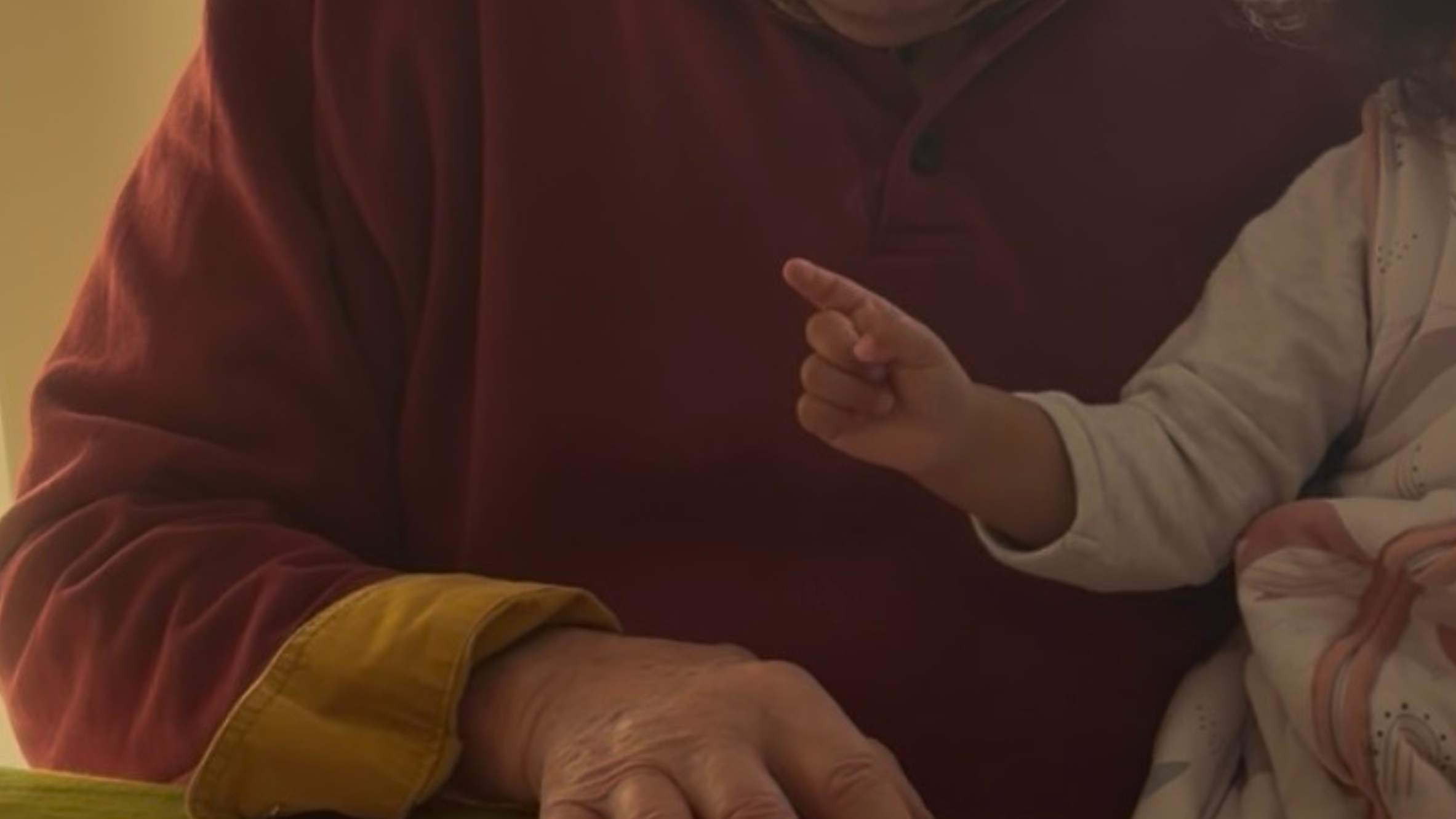
I don’t remember the exact day, but I remember the exact sweet moment. She is on the carpet, blabbering to herself and pretending to give a small doll a nappy change. It’s autumn so she must be 18 months old or thereabouts. I am doing something mundane, folding clothes, or maybe sneaking away for a tea, while singing one of her absolute favourites — Wind the Bobbin (the soundtrack of my life oscillates between Sleepy Bunnies, Nella Vecchia Fattoria, Baba Black Sheep and Stella Stellina depending on the time of the day, but I digress). She announces, without looking up, ”Mamma, [insert noise that sounds a bit like ‘kata’] Nonno.”
It takes me a moment to twig what she is saying. We have recently come back from Italy where we spent a bit of time with my parents, her grandparents, her Nonno e Nonna, and Nonno does have a big booming voice and likes to sing made-up songs, partly because he doesn’t know the lyrics. So it does take me a moment but I then get it. She wants me to sing (canta) in Nonno’s voice.
So I do. I clear my throat, drop my voice an octave or two lower than feels natural, puff my cheeks, and begin: Wind, wind, wind the bobbin up. Wind, wind, wind the bobbin up. It is a children’s song about factory work invented in nineteenth-century Lancashire (I had to look this up). I am singing it in the voice of an Italian grandfather, in a kitchen in London, to an 18 month old who has not noticed anything strange about this arrangement at all. She nods along, satisfied. I continue.
When the song ends she says, ”Altra, Nonna.” which in her world of word associations I take to mean ’once more, like Nonna’. My voice changes again — thinner now, gentler, a little quavering, the way her Italian grandmother actually sounds on the phone. Wind, wind, wind the bobbin up. Same song, second voice. She listens like a small conductor. When I finish she says, ”ancora” again, and we go around once more.
This is a thing that happens in our house now. It happens several times a day. Sing it like Nonno. Sing it like Nonna. It applies to every song in her repertoire — the English ones, the Italian ones, the Sinhala lullaby her Seeya, her paternal granddad, sings her. All of them now come in three versions: my voice, Nonno’s voice, Nonna’s voice.
She has begun to sing them in those voices herself. She announces it, like a tiny presenter: Adesso canto come Nonno. Now I sing like Nonno. The cheeks puff. The voice descends. The wheels on the bus, Giro Giro Tondo, Tikiri Tikiri Tikiri Liya (ටිකිරි ටිකිරි ටිකිරිලියා) — all of them, sometimes, are sung in the deep booming voice of a man neither she nor I see in person more than once every few months.
I am a linguist by training, and I cannot help asking what this is, exactly.
Three languages live in our house. Italian with me, English with her father and pretty much everywhere else — the nursery, the playground, the world — some Sinhala from her father’s heritage, a sprinkling of German from my years abroad. Two sets of grandparent voices live in our house too. The Italian ones — my parents — who we video call once or twice a week from a small town outside Milan. The Sri Lankan ones — her papi’s parents — who we call in Australia where they live, and read picture books over a slightly grainy connection. She loves all four of them. She has limited time with any of them — both sets live across a sea — and what she has of them, she takes very fondly, and seriously. And here let me pause a moment to acknowledge how lucky she is to have four wonderful grandparents. As someone who grew up with only two Nonnas, one of whom lived with us, I delight in the fact that she has them all, alive and well.
But the voices she imitates are specifically Italian. Nonno. Nonna. Not — for example — the voices of seeya and Ba, or technically Achie, her Sri Lankan grandfather and grandmother. She adores them too. They sing to her too, when we visit. She does not, however, do their voices.
I will come back to that. The Italian ones, first, arrive in our house as voices.
I think this is mostly about how the languages themselves carry voice.
Italian is, of all her languages, the most prosodic. It is what linguists call a syllable-timed language — every syllable holds roughly equal duration, and the music of the sentence comes from pitch and timbre and stress rather than from the rhythmic compression that English does. You can sing Italian in a way you cannot quite sing English. You can also tell whose voice an Italian sentence is in, even if the words don’t change. The pitch range carries more identifying information than it does in English.
Anne Fernald’s cross-linguistic work on infant-directed speech — the high-pitched, sing-song register adults use with babies the world over — showed that the language behaves differently in this register across cultures. Italian motherese carries a noticeably wider pitch range than English motherese. Italian mothers, technically, do not speak to their babies. They sing to them (and btw, I take this to another level as I literally sing through our day: it was from very young the only thing that seemed to settle my daughter, which is ironic if you knew me and my shocking singing voice).
What Italian exaggerates, a small Italian-listening child notices. She is sorting voices the way another child might sort colours: Nonno is one voice, Nonna is another. They are categorically different in a way that her English-speaking grandparents — for whom the pitch range is narrower, the cadence less punctuated — are not, to her ear, quite as different from each other.
So when she wants to play with voice, she reaches for the Italian set. They are the most legible voice-pair she owns.
Beneath this, something else is happening that I find remarkable.
Around the age of two, children begin to develop what linguists call register variation: the conscious ability to use their voice to indicate something about the speaker, the role, the situation. The classic example is a toddler addressing a baby in a higher-pitched, gentler voice than the one she uses with her father. It is a sign of an emerging theory of mind — the slowly-arriving recognition that other people have inner lives different from her own, and that you can hold them in mind well enough to imitate them.
Bilingual children tend to develop register variation a little earlier than monolingual children, because they are already, by necessity, practising language-switching from the moment they have language at all. They have learned that the same person can be addressed in different ways and the same chair called something different depending on who is in the room. That awareness — the I can switch — gets internalised early, and it doesn’t only switch languages. It switches voices, roles, characters.
When she sings Wind the Bobbin Up in Nonno’s voice, she isn’t mimicking, rather it is metalinguistic awareness, in toddler form. She is holding a voice in her head as a separate object from the language it speaks, and she is applying it to whatever song she likes. She has discovered that voice and language are decoupled.
So I guess this is a developmental win; and also, frankly, the cutest thing to watch.
It is no accident, I think, that the test material she has chosen is nursery rhymes.
Nursery rhymes are built for prosody. Wind the Bobbin Up, Giro Giro Tondo, Tikiri Tikiri Tikiri Liya — or any of the dozen others, are all constructed of rhythm, rhyme and repetition. They don’t have fantastically memorable lyrics, they are not even particularly good songs (if you ask me). They have survived and keep going strong in my view because they tune the ear and give a child a framework on which to hang the strange and irregular shapes of her language. They are, in a sense, language-training disguised as fun.
Layering voice-play on top of nursery rhymes is double work. You are practising the rhythm and rhyme and stress patterns of the song and you are practising the timbre and pitch of a particular speaker. And it seems to me that for a multilingual child, this is exactly the kind of layered exercise she is built to enjoy. Of course she does it. Of course she asks for it. Of course she announces Adesso come Nonno. It’s her gym, and she is loving doing reps.
The other part that really touched me, and I think the essay is actually about — is what happens when I notice that the Italian grandparents arrive in our house through voice and the Sri Lankan grandparents arrive in our house through story.
Her Seeya and Ba are present in her life in a completely different form. During our last visit, they read my daughter many books, and a couple really stuck with her, to the point we still read one of them every night before bed, the story of a cheeky black cat called Slinky Malinki (or Slinky Inky, if you asked her). She does things with her Sri Lankan grandparents that she does not with her Italian ones. She knows what their garden smells like. She knows what their favourite food smells like. She does not do their voices, but she can tell how Ba likes to water her plants, or Seeya likes to prepare his Weetabix for breakfast.
And I love noticing these subtle differences.
They tell me that absent grandparents arrive in a child’s life through whatever channel best matches them. The channel is partly a function of language access, partly a function of geography, partly a function of who the grandparents themselves are. The Italian grandparents are vocally expressive (aka loud and with constant chattering) in person and video, they sing along to nursery rhymes even when they don’t know the words; their voices are in the air. The Sri Lankan grandparents love to tend to the garden, to feed birds and observe other small creatures, to cook traditional foods and to read lovely books with my daughter; they are, in a way, on the page.
Both are real, precious forms of presence-making across distance.
What it teaches me — and might be useful to other parents — is that the trick of staying close to relatives who live far away is not necessarily to spend more time, which is often impossible. The trick is to find the channel that fits the person. Some grandparents are voices. Some are stories. Some are recipes — the smell of a kitchen well lived. Some are objects — a single wooden spoon that arrives in the post. Some are practices that a child learns from afar — a way of dipping the tea bag in the mug, of talking to the birds, of singing softly to herself in the bath.
The child will pick the perfect channel for each of them — and it’s a delight to witness.
A few small offerings, if any of this is useful to you.
For the parents of multilingual children with relatives — grandparents, aunts, uncles, godparents, family friends who function like family — who live a long way away:
Send the voice. Not just video calls, where the connection is patchy and the child is shy. Send recorded songs. Send lullabies sung straight into the phone, badly, with no pretence. Ask a grandparent to record themselves singing the thing they sang to your partner as a child. Ask an aunt to record the song she used to fall asleep to, or to read a short book you both have. Play them at bath time. The voice is a kind of presence the algorithm cannot dilute.
Send the story: buy picture books from the heritage country, even if you can’t yet read them aloud yourself. Ask the relative to record themselves reading one in their own language. Ask them to write down — in their own language, no translation needed — the bedtime story they remember from their own childhood. Slip the words into your child’s life.
Send the object: a small thing in the post that has a connection to a shared experience, however small. A spoon, a doll, a piece of cloth, a dried flower. Things have a stubborn way of carrying the person who owned them.
Send the practice: a way of doing something. A song before food. A morning prayer. A pose, a gesture, a habit. Children pick these up and turn them into their own without knowing they are doing it.
Don’t impose ‘the channel’: watch what your child does spontaneously, and trust it. If she wants to sing in Nonno’s voice and not in Seeya’s, that is information about how she is processing two heritage lines. The most trusting response is to widen each channel — not to redirect it. If Seeya reaches her through story, send more stories. If Nonno reaches her through song, send more songs.
Encourage voice-play of any kind: it is a developmental win, and it is free.
It is Saturday morning now. She is in the garden. She is singing, quietly, to herself, Tikiri Tikiri Tikiri Liya. The likely mispronounced Sinhala syllables float across the space and out into the day. After a few bars she pauses, looks at me, and says, ”Adesso come Nonno.”
So she sings in a deep voice, cheeks puffed, lips closed together with the same seriousness with which an Italian grandfather might announce, on a hot August afternoon, that it’s now time for a stroll and a gelato. She finishes. She nods, satisfied. She begins again, come Nonna this time, very softly, almost mouthing the words.
Three languages, two voices, one small body on a London patio. Somewhere outside Milan, a Nonno is reading the daily paper finishing his espresso. Somewhere outside Sydney, a Seeya is engrossed in a police thriller book. None of them know what she is doing. All of them are present.
This is the long embrace of grandparents who live overseas. A child puts her arms around them instinctively. The grandparents barely have to do a thing.
— Paola
---
Sowing Tales is a publication on slow, screen-free, multilingual childhood. Letters about once a fortnight, free. If this resonated, subscribe at the top of the page.
---
Sources
These are the sources that back the linguistic and developmental claims I lean on in the essay, mapped to the line of argument it supports, with a note where the literature is more specific than I am (and how fascinating it is to come back to this way of writing and researching, after a good few years).
”Italian is a syllable-timed language… you can sing Italian in a way you cannot quite sing English.”
- Pike, K. L. (1945). The Intonation of American English. University of Michigan Press. The original distinction between stress-timed and syllable-timed languages.
- Ramus, F., Nespor, M., & Mehler, J. (1999). Correlates of linguistic rhythm in the speech signal. Cognition, 73(3), 265–292. The empirical basis for grouping Italian and Spanish as syllable-timed against the stress-timed Germanic languages including English. https://www.sciencedirect.com/science/article/abs/pii/S0010027799000581
”Italian motherese carries a noticeably wider pitch range than English motherese.”
- Fernald, A., Taeschner, T., Dunn, J., Papousek, M., de Boysson-Bardies, B., & Fukui, I. (1989). A cross-language study of prosodic modifications in mothers’ and fathers’ speech to preverbal infants. Journal of Child Language, 16(3), 477–501. The foundational cross-linguistic comparison. Italian — alongside other Romance languages — shows the widest pitch excursion in mothers’ speech to infants. https://www.cambridge.org/core/journals/journal-of-child-language/article/abs/crosslanguage-study-of-prosodic-modifications-in-mothers-and-fathers-speech-to-preverbal-infants/
- Fernald, A. (1989). Intonation and communicative intent in mothers’ speech to infants: Is the melody the message? Child Development, 60(6), 1497–1510. The companion paper on why this pitch-range exaggeration matters for the infant ear.
”Around the age of two, children begin to develop register variation… It is a sign of an emerging theory of mind.”
- Andersen, E. S. (1990). Speaking with Style: The Sociolinguistic Skills of Children. Routledge. The classic study of how young children adjust voice and register to mark speaker, role, and situation.
- Wellman, H. M., Cross, D., & Watson, J. (2001). Meta-analysis of theory-of-mind development: The truth about false belief. Child Development, 72(3), 655–684. The standard meta-analysis on theory-of-mind emergence — strictly speaking the *false-belief* shift happens later (around 3–4), but the precursor capacities, including the kind of speaker-as-other modelling that register-switching requires, are present from around two. https://srcd.onlinelibrary.wiley.com/doi/10.1111/1467-8624.00304
”Bilingual children tend to develop register variation a little earlier than monolingual children… metalinguistic awareness, in toddler form.”
- Bialystok, E. (2001). Bilingualism in Development: Language, Literacy, and Cognition. Cambridge University Press. The standard reference on bilingual cognitive flexibility and earlier metalinguistic awareness.
- Bialystok, E. (2009). Bilingualism: The good, the bad, and the indifferent. Bilingualism: Language and Cognition, 12(1), 3–11. A more accessible review that includes the register-switching advantage. https://www.cambridge.org/core/journals/bilingualism-language-and-cognition/article/abs/bilingualism-the-good-the-bad-and-the-indifferent/
”Nursery rhymes are built for prosody… they tune the ear.”
- Trehub, S. E. (2003). The developmental origins of musicality. Nature Neuroscience, 6(7), 669–673. Trehub at the University of Toronto on infant musicality and the overlap between music and language processing in the developing brain. https://www.nature.com/articles/nn1084
- Patel, A. D. (2008). Music, Language, and the Brain. Oxford University Press. The book-length treatment of the music-and-language overlap that underlies why rhythmic, rhyming, repetitive material lands so well for young children.
Honesty flag: the “bilingual register-switching advantage” line is supported by the literature but the size of the advantage is contested in the broader bilingual-cognitive-advantage debate (see Paap, Johnson & Sawi 2015 for the sceptical reading). I’ve kept the claim to an observable minimum — that bilingual children practise switching from earlier — which is hard to dispute.
I love this Paola how sweet and interesting! The children of our future :)